
#Precision
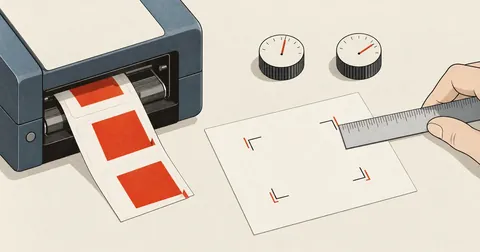
Labels Printing Off-Center? Calibrate the Print Offset Once
After getting the label printer to fire its printhead, the next problem was that the text missed the sticker. I stopped guessing and printed rulers and corner markers to measure it, then clearly separated paper size, printable area, and offset into three distinct values.
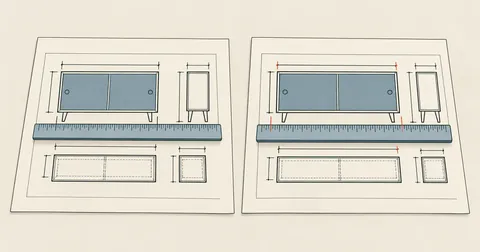
Drawing SVG Electrical Panels You Can Measure on Paper
The electrical panel drawings I generated from HTML looked good, but the technician said the proportions were wrong. I rebuilt the whole sheet, anchored it to actual catalog dimensions, wrote the viewBox directly in millimeters, and added a scale bar so the technician could use a ruler to verify that the drawing in hand really was at 1:10.
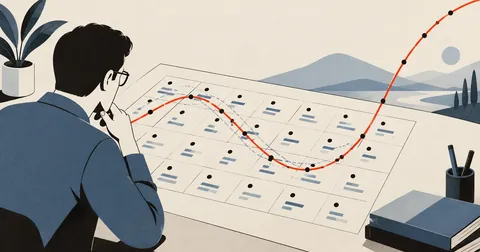
Reverse Engineering Spreadsheet Constants into Formulas
A sheet has a criteria table sitting beside the calculations, but no VLOOKUP connects them. People read the table and type values into cells themselves, and mistakes go unnoticed. This article covers separating formula cells from manually entered cells, then reconstructing a single formula that matches all 16 values in a multiplier column.
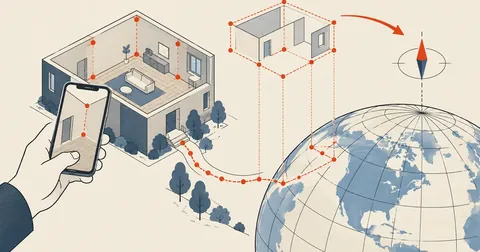
Mapping a Building by Phone and Finding True North with GNSS
ARCore gives room-corner coordinates in meters accurately enough to use, but its world frame has an unknown orientation, so the resulting plan is always rotated by some angle. The fix is to collect pairs of (AR position, GNSS reading) while working, then fit a rotation using weighted 2D Kabsch, with weights based on each fix's accuracy, to find both north and the origin's coordinates.
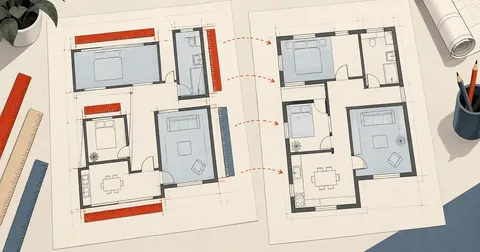
Rebuilding an Off-Scale PDF Plan at Real Dimensions
Presentation plans are often drawn block by block, with different scales for the x and y axes and different scales again for each room. Calibrating the whole page once and tracing it gets everything wrong. This article covers extracting coordinates from paper into metres by recalculating the scale for every room, counting objects with colour-blob BFS instead of by eye, and drawing them back into a model at their real dimensions.
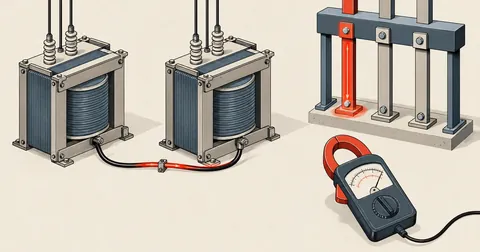
Shared Neutrals Across Transformers: Why Phase Balancing Is Not Enough
A case involving two transformers with interconnected neutrals and houses tapped into one side's main feeder, leaving phase A 30-40 A higher even on days off, plus a meter-reading trap that can suggest a 200 A difference if the CT ratio is not verified first, and a repair sequence that must be followed in order.
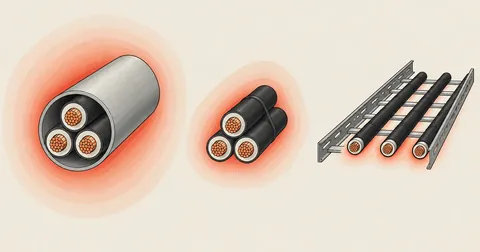
Sizing Main Cables and Breakers by Installation Method
Notes on choosing the main cable and breaker for a new 253 A feeder, why the same size CV cable can carry 227 A or 364 A depending on how it is installed, and the option of downsizing to 95 and compensating with operating rules, at the cost of the main breaker tripping if anyone breaks those rules.
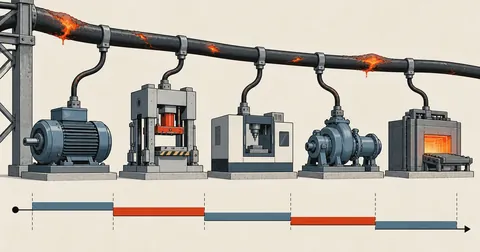
Diagnosing Feeder Overload from Melted Insulation and Duty Cycles
My investigation of a 95 mm² main cable with insulation melting at scattered points even though the system seemed to work normally, from the nameplates of 6 washers and dryers totaling 234.7 kW to a minute-by-minute current model explaining why a 482 A load on a cable rated for 180 A had not caused a visible system failure.
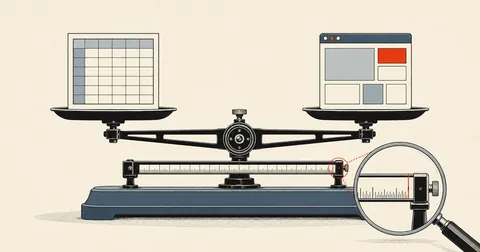
Porting Excel Formulas to the Web: Floating-Point Traps
Porting engineering formulas from an Excel file to a web calculator produced differences around 1e-13 — not a math bug, but differences in how JS and Excel evaluate floating-point powers and multiplication order, with a method for reading formulas and values separately using openpyxl and building fixtures that actually catch regressions.