#Web Security

Let Clients Pick Photos on a Web Page Without a Login
When the person choosing photos for a website is not comfortable with computers, adding registration and login means the work stops at the login screen. This article covers a photo picker with no authentication at all, but with a server endpoint that checks every value against an allowlist strict enough to leave nothing from arbitrary input, plus limits at every layer and a backup before every write.

Building a Graph API Page App with Three Required Endpoints
When a backend needs to read and reply to Page messages on its own, the only proper route is to build an app and pass the platform's review. This article covers three endpoints the platform requires but people forget until they fail review, the correct way to verify incoming request signatures, and the steps to exchange a short-lived token for a Page token stored outside the web root.
A Report Form for a Static Site with No Backend
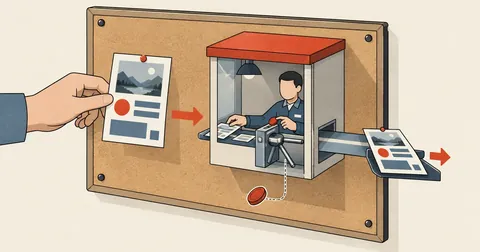
A calculator site made entirely of static files has no server to handle forms, but users still need a way to report mistakes in the formulas. This article covers the one approach I chose—a single worker file that accepts POST requests on one route, verifies Turnstile on the server using the real client IP, accepts images pasted from the clipboard, and sends email from the network edge—along with three traps that cost me an entire night.

A Cookie Banner That Loads GTM and GA4 Only After Consent
Most cookie banners look good but block nothing, because GTM and GA4 have already loaded from the first line of the page. This article covers a setup that loads the container only after acceptance, puts GA4 inside GTM to prevent double counting, hides AdSense slots initially, and checks that outgoing requests to those services stay at zero.

Reading ID Cards from the Web with a Localhost Agent
Browsers cannot access smart card readers directly. A workable approach is to write a small agent that opens a port on localhost and let the web page call it. This article covers secure contexts, CORS preflight, port conflicts with other agents, PC/SC in SHARED mode, decoding TIS-620 manually, and the day antivirus flagged the program as a backdoor.

Let AI Read Documents, but Let Code Do the Math
The controller requires manually entered values to fall between 0 and 100, but the path where AI reads values from documents and feeds them in only checks whether they are numeric. A single negative value inflated the result to 5.25 times what it should have been without an error — a lesson in treating AI output as untrusted input, just like values entered by people.

A Single-Page PHP and SQLite Document Vault That Keeps Originals
A document photo storage app for government submissions, using photos taken on site with a phone. Each upload produces three files—the display image, the original, and saved crop settings—so adjustments can be made later without losing quality, with automatic migration from JSON to SQLite and web server restrictions on folders containing personal data.

Auditing a Deployed Laravel Site — 3 Layers in Priority Order
After deploying Laravel to production, check security in 3 layers — probe externally for exposed endpoints, check files/permissions on the server, then grep for vulnerabilities in the code. This article provides commands and P0-P2 priorities for deciding what to fix first.

nginx heap overflow spans 15 years—version checks aren't enough
CVE-2026-42533 affects nginx versions 0.9.6 through 1.31.2, spanning 15 years, but actual exposure depends on the config, not the version. The problem is that news reports describe narrower conditions than the real ones. Checking against those reports can return "safe" even when the config still meets the conditions.