#API

Passing the Sandbox Doesn't Mean It Works — 7 False Signals
The automated ordering system I wrote passed every command in a provider's sandbox, but almost everything the sandbox told me differed from reality, from response times and charges to accepted names and items that were created successfully but could not be found. Here are 7 false signals and how to write code that does not fall for them.

Bank Open API QR Payments — From Sandbox to Status Lifecycle
A static PromptPay QR is easy to build yourself, but nothing tells you whether the customer has paid. This article walks through a bank's Open API sandbox, from requesting a token and issuing a dynamic QR to tracking REQUESTED/PAID/CANCELLED/VOIDED states and the requestDt trap that rejects requests even when the entire payload is correct.

Building a Graph API Page App with Three Required Endpoints
When a backend needs to read and reply to Page messages on its own, the only proper route is to build an app and pass the platform's review. This article covers three endpoints the platform requires but people forget until they fail review, the correct way to verify incoming request signatures, and the steps to exchange a short-lived token for a Page token stored outside the web root.
A Report Form for a Static Site with No Backend
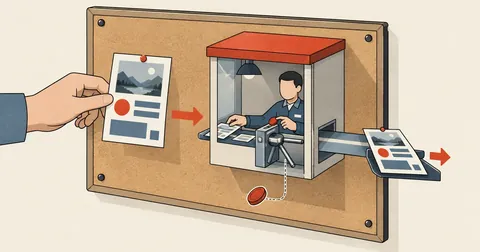
A calculator site made entirely of static files has no server to handle forms, but users still need a way to report mistakes in the formulas. This article covers the one approach I chose—a single worker file that accepts POST requests on one route, verifies Turnstile on the server using the real client IP, accepts images pasted from the clipboard, and sends email from the network edge—along with three traps that cost me an entire night.

Making 20,000+ API Calls That Resume Without Leaving Corrupt Files
Generating 26,850 files through an API limited to 20 calls per minute requires three pieces—a system-wide throttle, resuming from what is already on disk, and a separate file validator—because files interrupted by network failures still have the right extension and a nonzero size.

Cannot Delete Faces from a Terminal: API Returns notSupport
The door's face recognition terminal advertises a command to delete faces from FDLib, but every variation I tried returned notSupport. People who had left could still scan their faces and get in. This article covers the dead ends, the approach that actually worked using UserInfo/Modify with the smallest possible body, and the two-way user registry sync that runs every night.

Writing to DirectAdmin Through Panel Forms When the API Only Reads
Notes on letting a back-office app create and edit hosting packages in DirectAdmin when the official CMD_API only provides read operations, requiring POST requests directly to control panel forms, with verification rules that prohibit regex and two layers of kill switches disabled by default.

Registrar and Billing NS Mismatch: Audit All Three Sides First
A debugging log for "Wrong response from the server" when changing nameservers in a billing system, which failed only for domains with leftover glue IP data, followed by a three-way audit of the registrar, billing system, and actual DNS zones before I felt confident changing anything.

Moving JSON Time Series to Columns Without Changing the Dashboard
I stored entire device frames as JSON arrays at one row per second. After two weeks, the tables had grown to 183 MB at the endpoint and 625 MB on the server, with JSON_EXTRACT queries that could not use an index — here is how I moved the data into int columns and had the API rebuild a sparse array without changing a single line of the dashboard.

Always Claim the State Before Sending Anything Out
A "read the state, then send" guard looks safe until a worker gets killed after sending but before writing to the database, and a retry sends the same thing to the customer twice. This article covers the full set of duplicate prevention measures I use, from atomic claims to retry_after and failed() handlers that must never overwrite a successful state.

News Stuck for Three Days Because the Feed Wasn't Sorted by Date
The news site's homepage showed the same day's stories for three days straight, even though scheduled jobs ran, translations finished, and every step reported success. The causes were an RSS feed sorted by relevance rather than date, string sorting of pubDate that actually sorted by weekday name, and requesting too few stories, leaving nothing after filtering before the rest even got a look.

Sending Automated Job Files to Telegram and the Bot API's 50 MB Limit
Set up a small local service that takes files from scripts and sends them to me on Telegram, with outbound delivery only, no polling, and no incoming commands, along with the actual Bot API limits to know before writing it, including 50 MB per file, images over 10 MB that must be sent as documents, and the Thai text trap in curl on Windows.

Managing Site Switches Remotely with UniFi's Cloud Connector Proxy
My workstation is in a different location from the site, with no VPN and no inbound ports open, but I still need to change VLANs per port, reserve fixed IPs, and track down failing cables. This article explains how Site Manager's connector proxy reaches the legacy API for both reads and writes without requesting a CSRF token, and the discipline needed when holding a key this powerful.
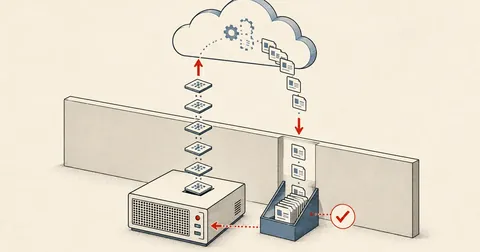
Factory to Cloud Behind NAT: Push Snapshots and a Command Queue
The production machine sits in a LAN behind NAT with no public IP, but the owner wants to view data on a cloud website and make edits from a phone that reach the internal machine — possible without opening ports or setting up a VPN, using push snapshots + an edit command queue + idempotent acks

Control TP-Link Omada OC200 via REST API with Python
A practical guide to logging into an OC200 controller through REST API v2 with Python — handling CSRF tokens, self-signed certs, fetching sites/devices/SSIDs/DHCP/port-forward rules, and writing back with PATCH, including the read-only fields that cause a nonzero errorCode

Generate PromptPay QR (EMVCo) in Pure Python — No External Libraries
Want to generate PromptPay payment QR codes in your own POS/web system without calling a bank API? In this article, I build the EMVCo TLV string + CRC16 myself in pure Python, producing a payload that matches the Thai QR specification and can be scanned for payment by any banking app, along with the pitfalls that stop apps from reading it.